




In recent years, sustainability has evolved from a corporate buzzword into a strategic priority for organizations worldwide.
Investors, regulators, and consumers increasingly expect companies to demonstrate responsible environmental practices, ethical governance, and a commitment to social responsibility. Furthermore, its obligatory to assess & declare the potential impact of climate risk on the corporation’s operations and results. These expectations are now formalized through regulations, sustainability reporting frameworks, and investment criteria.
As a result, many organizations are turning to professionals who specialize in integrating sustainability into business operations. An ESG Consultant plays a vital role in helping companies navigate this transformation by aligning environmental, social, and governance considerations with business strategy and regulatory compliance.
Today, ESG is no longer limited to corporate social responsibility initiatives. It has become a framework used to evaluate corporate(climate) risks, long-term sustainability, and business resilience. Organizations that adopt structured ESG practices often benefit from stronger investor confidence, improved operational efficiency, and greater regulatory readiness.
This guide explores what an ESG Consultant does, the services they provide, and how ESG strategy can create measurable business impact.
ESG stands for Environmental, Social, and Governance, three categories used by investors and organizations to evaluate a company’s sustainability performance and long-term risks.
In financial markets, ESG factors are increasingly integrated into investment decisions. Institutional investors now analyze sustainability metrics alongside financial performance to assess whether companies are managing environmental impacts, maintaining responsible labour practices, and operating with transparent governance.
Several international frameworks have emerged to standardize ESG reporting. Examples include the Corporate Sustainability Reporting Directive (CSRD) in the European Union, the EU Taxonomy for sustainable activities, and global sustainability standards developed by the International Sustainability Standards Board (ISSB).
These frameworks require organizations to measure and disclose sustainability-related risks, impacts, and strategies. For many companies, implementing these requirements can be complex because ESG data must be collected from multiple departments, evaluated against regulatory frameworks, and integrated into long-term strategy.
This growing complexity is why many organizations rely on ESG consulting services to design structured sustainability strategies and ensure regulatory alignment.
An ESG Consultant is a professional who helps organizations develop, implement, and report sustainability initiatives aligned with environmental, social, and governance principles.
These professionals work at the intersection of strategy, regulation, and operational transformation. Their role is to translate sustainability expectations into practical frameworks that organizations can integrate into everyday business operations.
An ESG consulting company typically assists clients with sustainability strategy development, ESG data management, compliance with disclosure regulations, and risk assessment. In many cases, an ESG consultant also works closely with finance teams, risk managers, operations leaders, and executive leadership to embed sustainability into corporate governance structures.
While sustainability has historically been treated as a separate initiative, modern ESG strategy integrates sustainability into core business decision-making. This includes evaluating environmental risks in supply chains, incorporating sustainability metrics into executive incentives, and aligning corporate reporting with regulatory standards.
In essence, an ESG consultant helps companies transform sustainability commitments into measurable strategies and operational outcomes.
The responsibilities of an ESG Consultant can vary depending on the organization and industry. However, most ESG professionals focus on five key areas: assessment, strategy development, implementation, reporting, and compliance.
First, consultants help organizations identify material ESG issues. This involves analyzing how sustainability risks affect business performance and how business operations impact the environment and society. This process is often called materiality assessment, a critical step required under many sustainability frameworks.
Second, ESG consultants support companies in developing sustainability strategies. These strategies may include carbon reduction targets, supply chain transparency programs, diversity and inclusion initiatives, or governance reforms.
Third, consultants help design ESG data management systems. Sustainability reporting requires accurate data related to emissions, energy use, labour practices, and governance policies. Many organizations lack integrated systems for collecting and verifying this data.
Fourth, ESG professionals assist with regulatory reporting and disclosure. This includes aligning sustainability reports with standards such as CSRD, EU Taxonomy, ISSB, or TCFD climate disclosures.
Finally, consultants help organizations implement sustainability initiatives across operations. This may involve improving energy efficiency, developing responsible sourcing policies, or integrating ESG performance indicators into corporate governance.
These responsibilities are typically delivered through structured ESG advisory services that combine regulatory expertise, strategic planning, and operational guidance.
Businesses today face increasing pressure to demonstrate sustainability performance. Regulators are introducing stricter reporting requirements, investors are incorporating ESG criteria into capital allocation decisions, and customers are prioritizing responsible companies.
However, implementing ESG practices can be complex. Sustainability initiatives often require cross-department collaboration, data management systems, and regulatory interpretation.
An ESG Consultant helps organizations overcome these challenges by providing specialized expertise.
One major reason companies seek ESG consulting services is regulatory complexity. Sustainability regulations differ across jurisdictions and continue to evolve rapidly. Advisors help organizations interpret these regulations and ensure their reporting processes meet compliance standards.
Another challenge is data availability. Many organizations lack established systems for collecting sustainability metrics. Consultants design frameworks that allow companies to gather reliable ESG data across operations and supply chains.
Finally, organizations often struggle with strategic integration. Sustainability initiatives sometimes operate separately from core business functions. ESG advisors help embed sustainability into risk management, corporate governance, and operational planning.
With professional guidance, businesses can transform ESG from a compliance obligation into a strategic advantage.
A critical role of an ESG Consultant is developing structured sustainability strategies aligned with business objectives. These strategies typically include climate targets, responsible sourcing initiatives, and governance improvements.
Through ESG strategy consulting, advisors help companies set measurable goals, align sustainability with corporate values, and establish accountability mechanisms.
ESG consultants help organizations identify environmental, social, and governance risks that may affect financial performance. These risks may include climate regulation changes, supply chain labour issues, or governance failures.
By identifying these risks early, companies can develop mitigation strategies and strengthen long-term resilience.
Organizations must regularly evaluate their sustainability performance. ESG consultants assist with benchmarking, performance metrics, and progress monitoring.
These assessments help companies understand where they stand relative to competitors, investors, and regulatory expectations.
Strategy development alone is not sufficient. ESG consultants also support implementation across operational departments.
This may involve introducing renewable energy initiatives, improving waste management processes, strengthening supplier transparency, or implementing employee wellbeing programs.
Reporting is a critical component of ESG strategy. Investors and regulators expect companies to provide transparent disclosures about sustainability performance.
Consultants ensure reporting aligns with recognized frameworks and regulatory standards. This includes preparing ESG reports, ensuring audit-ready documentation, and building governance processes that support reliable disclosures.
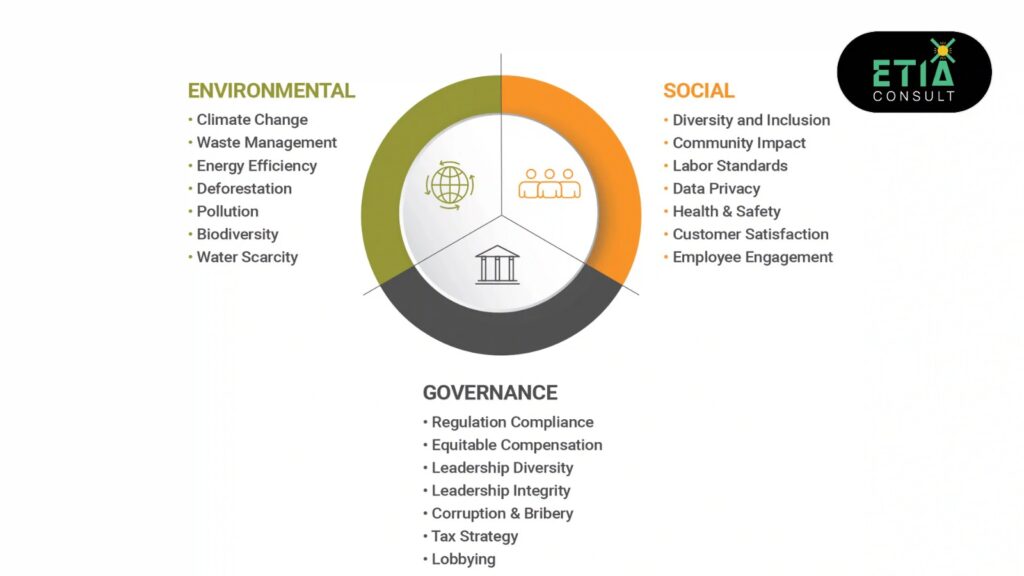
Environmental considerations focus on how organizations interact with natural ecosystems. Key issues include greenhouse gas emissions, energy consumption, water usage, biodiversity protection, and waste management.
Companies in energy-intensive sectors must pay particular attention to environmental risks such as carbon pricing policies and climate regulations.
Social considerations examine how organizations treat employees, suppliers, customers, and communities. This includes workplace safety, diversity and inclusion, labour rights, and human rights in supply chains.
Social failures can quickly lead to reputational damage, legal challenges, and operational disruptions.
Governance refers to how companies are managed and controlled. Strong governance structures include independent board oversight, ethical leadership practices, anti-corruption measures, and transparent reporting.
Effective governance is often the foundation for credible sustainability initiatives.
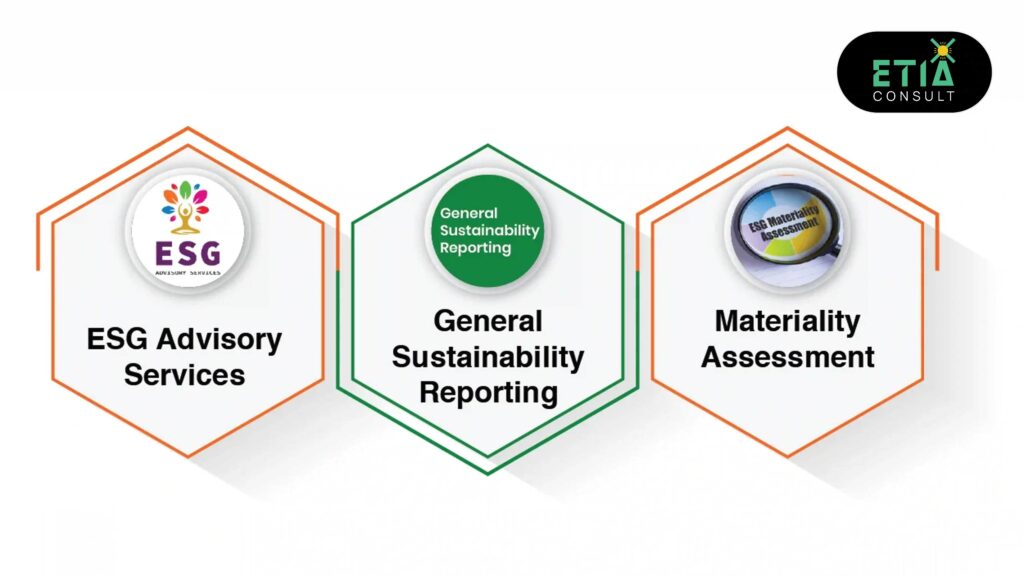
Different organizations require ESG expertise depending on their sector, size, and regulatory environment. ESG consulting services are commonly delivered across multiple sectors.
Banks, asset managers, and investment firms increasingly integrate ESG metrics into lending and investment decisions. ESG consultants help financial institutions evaluate sustainability risks in portfolios and align with responsible investment standards.
Large corporations face growing reporting obligations and stakeholder expectations. An ESG consulting company helps corporations develop sustainability strategies, manage ESG risks, and comply with regulatory frameworks.
Nonprofits and international organizations use ESG frameworks to measure social and environmental impact. Consultants assist with impact measurement and sustainability reporting.
Public sector institutions increasingly incorporate sustainability into infrastructure planning, procurement policies, and climate strategies. ESG consultants support policy design and sustainability assessment.
Small and mid-sized businesses are increasingly required to demonstrate ESG performance because of supply chain expectations and investor requirements. A sustainability consultant can help these companies build ESG frameworks early in their growth journey.
Sustainability has become a fundamental component of modern business strategy. Companies are expected to manage environmental impacts, maintain ethical governance practices, and demonstrate social responsibility.
However, integrating ESG principles into business operations requires expertise in strategy development, regulatory interpretation, data management, and performance reporting.
An ESG Consultant plays a crucial role in guiding organizations through this transformation. Through ESG advisory services and structured ESG strategy consulting, these professionals help businesses translate sustainability commitments into practical actions and measurable outcomes.
Organizations that adopt structured ESG strategies are better positioned to manage regulatory risks, attract responsible investment, and build long-term resilience in an evolving global economy.
An ESG Consultant helps organizations identify sustainability risks and opportunities, develop ESG strategies, implement operational initiatives, and align sustainability reporting with regulatory frameworks.
No. While large corporations face the most immediate reporting obligations, startups and mid-sized businesses increasingly require ESG consulting services due to investor expectations, supply chain requirements, and emerging regulations.
Industries with significant environmental and regulatory exposure benefit the most. These include energy, manufacturing, financial services, infrastructure, and supply chain-driven industries.
Sustainability consulting generally focuses on environmental and social initiatives. ESG consulting is broader and includes governance structures, regulatory reporting, and investor-focused sustainability metrics.
Common frameworks include the Corporate Sustainability Reporting Directive (CSRD), EU Taxonomy, ISSB standards, and climate disclosure frameworks such as TCFD.
Adding {{itemName}} to cart
Added {{itemName}} to cart